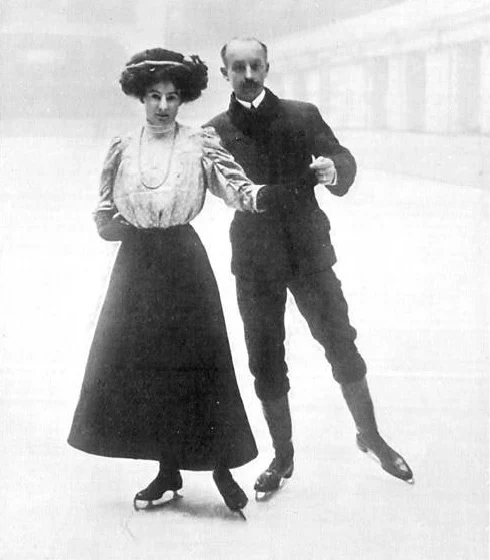
Silver in an event without a women’s division
At the 1902 World Championships, Florence Madelin ‘Madge’ Syers entered the only singles competition available. The entry rules left room for a woman to take part, and the organizers let Syers skate. She placed second behind Sweden’s Ulrich Salchow.
Syers had trained at Prince’s Skating Club in London. Her husband Edgar was also her coach and later her competitive partner. In 1902 she had to show her skating against the leading men. Her result made a case for a division in which women could regularly compete against each other.
A field of its own
Syers won the first ISU women’s championship in 1906 and defended it in 1907. The early fields already brought together skaters from different countries. Austria’s Jenny Herz was runner-up at both events. Hungary’s Lily Kronberger took bronze twice and won her first title in 1908, in Syers’s absence.
In that same era, singles skating still included compulsory figures. Judges inspected prescribed patterns traced on the ice. The event also included free skating, where the skater could bring steps, turns and other movements together in a program. The two sections rewarded different aspects of blade control.
Two Olympic medals in London
London 1908 staged figure skating in October at the rink Syers knew from training. Syers won the first Olympic women’s singles title, ahead of Elsa Rendschmidt and Dorothy Greenhough-Smith. Syers and Edgar also earned bronze in pairs.
Skaters returned to the Summer Games in 1920. The sport then moved to the Winter Games at Chamonix in 1924. By that point, women’s singles had a place at both the World Championships and the Olympics, built in the two decades after Syers entered that first World Championship.