History of figure skating
Figure skating made its Olympic debut at the 1908 Summer Games in London. By then, international competitions had already brought together skaters working under shared rules. The timeline follows what changed next, from new medal events to the way a program is scored.
Midori Ito’s triple Axel at the 1988 NHK Trophy
Ito landed the jump at NHK in 1988. Four years later, she landed it again in the Olympic free skate.
The timeline
1882–1907
The international beginnings
The International Skating Union (ISU) traces the first international figure skating competition to Vienna in 1882. As skating spread across borders, delegates met in Scheveningen, in the Netherlands, on 23 July 1892 to found the ISU and establish common rules.
The first World Figure Skating Championships, open to men, took place in St Petersburg in 1896, a decade before Madge Syers won the first separate ISU championship for women in Davos.
1908–1951
From summer to winter Olympics
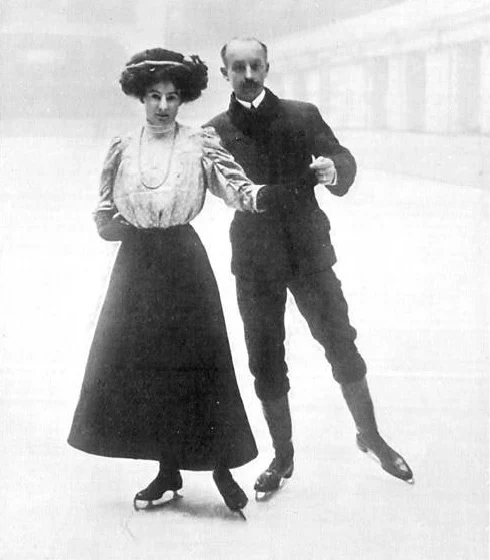
Figure skating made its Olympic debut at the London 1908 Summer Games, where Madge Syers won singles gold and shared pairs bronze with Edgar Syers. It returned at Antwerp in 1920 before joining the first Winter Games in Chamonix in 1924.
Norway’s Sonja Henie was 11 when she competed at Chamonix and went on to win Olympic gold in St Moritz in 1928, Lake Placid in 1932 and Garmisch-Partenkirchen in 1936.
1952–1988
The rise of ice dance
Ice dance joined the World Championships in Paris in 1952 and became an Olympic medal event in Innsbruck in 1976.
Eight years later, Britain’s Jayne Torvill and Christopher Dean won Olympic gold in Sarajevo with a free dance set to Ravel’s Boléro. The performance drew an estimated 24 million television viewers in Britain.
Singles skating reached a milestone of its own in 1988 when Midori Ito landed the first women’s triple Axel in international competition at the NHK Trophy.
1989–2005
New programs, new scoring
Midori Ito’s triple Axel helped her become Japan’s first world figure skating champion in 1989. The following year marked the end of compulsory figures, the set patterns skaters traced on the ice as a separate part of singles competition.
The ISU trialled a new judging system at the 2003 Nebelhorn Trophy and refined it for the 2004/05 season, scoring each element on its difficulty and execution.
2006–present
The modern era
Ice dancers Albena Denkova and Maxim Staviski won Bulgaria’s first world figure skating title in Calgary in 2006 and defended it in Tokyo in 2007. At Sochi in 2014, the first Olympic team event brought skaters from all four disciplines together to compete for a single team result.
The ISU started a new set of score records for the 2018/19 season when it adopted a scale of −5 to +5 for grade of execution.