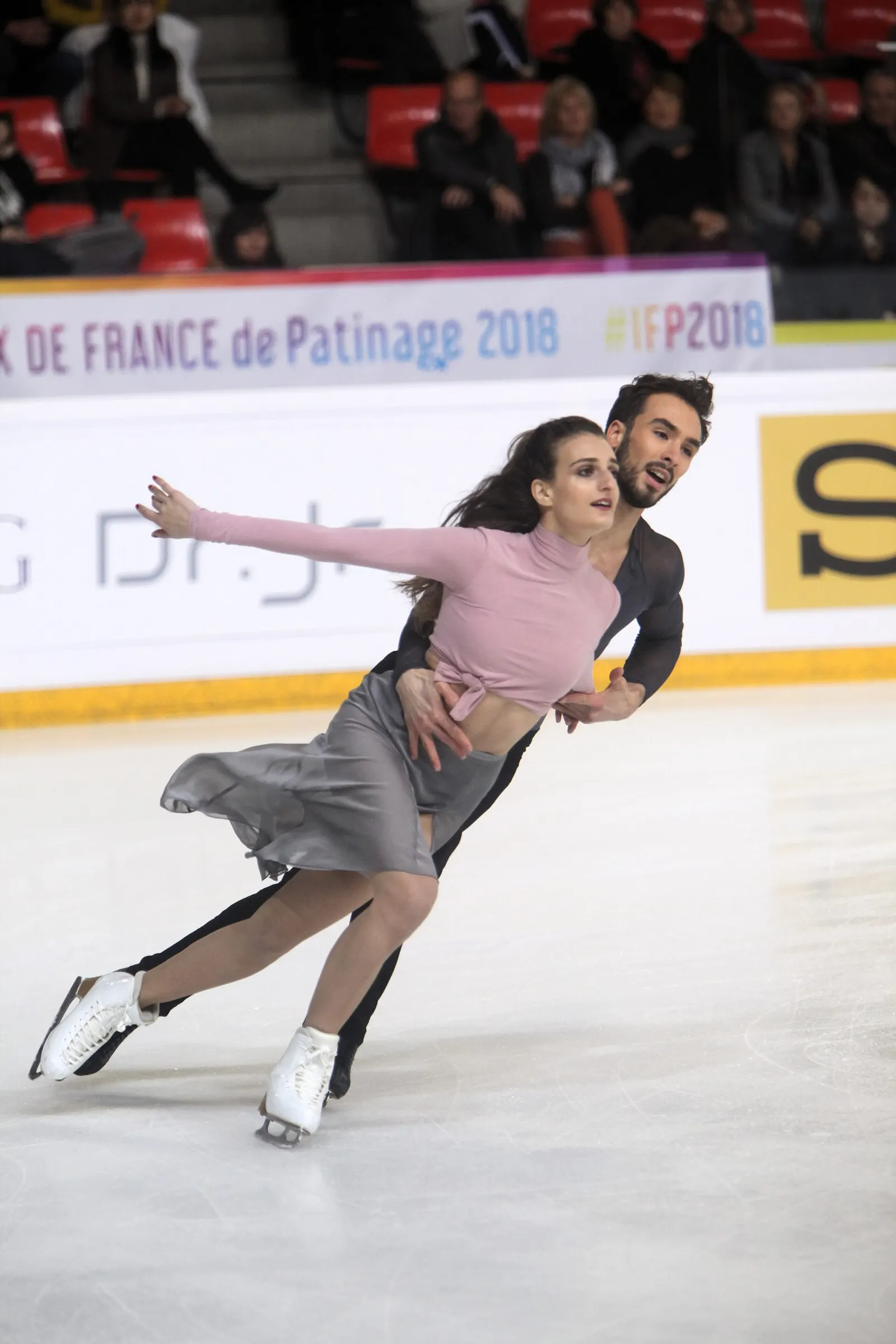
A discipline built around steps
By the 1930s, national ice dance competitions had appeared in North America, Great Britain and Austria. Ice dance developed around steps, holds and timing with the music. Pair skating had its own signature elements, including throw jumps and overhead lifts.
In 1950, the ISU presented ice dance as a special event at the World Championships. The discipline joined the official World Championship program two years later in Paris. It gained a place on the Olympic medal program in 1976 at Innsbruck, more than half a century after pair skating appeared at the first Winter Olympics.
The free dance that reached beyond the rink
At Sarajevo in 1984, Jayne Torvill and Christopher Dean used Maurice Ravel’s Boléro for their free dance. Its recurring theme and gradual build gave the team an arc to follow from their opening movements to the finish. They won Olympic gold. The IOC estimates that around 24 million people watched in Britain.
For viewers seeing ice dance for the first time, the performance demonstrated how a free dance could turn a piece of music into a full program. The competition still asked couples to skate prescribed patterns in a separate segment. Each couple followed the same steps to make timing, holds and edges directly comparable.
From compulsory dances to two programs
Pattern dances remained a stand-alone segment until 2010. Today, couples compete in the rhythm dance and the free dance. The rhythm dance follows requirements set for the season. The free dance gives couples more freedom in music and composition while still requiring specific elements.
Gabriella Papadakis and Guillaume Cizeron offer an example from that two-program era. The team won Olympic silver in 2018 and gold in 2022. At the 2022 World Championships in Montpellier, their free dance to Gabriel Fauré’s Élégie included two lifts, a spin and twizzles that the technical panel credited at level four. The protocol records the demands behind a program that depends on timing between two partners.